
Minnesota Marriage License Records
Minnesota marriage licenses are issued at the county level across all 87 counties in the state. Both parties must apply in person at any county recorder's office, no matter where you live or where the ceremony will take place. The Minnesota Official Marriage System at moms.mn.gov lets you search marriage records and request certified copies online. Whether you need to apply for a new license, look up a past Minnesota marriage record, or find contact information for your county's office, this guide covers what you need.
Minnesota Marriage License Overview
How to Get a Minnesota Marriage License
Marriage licenses in Minnesota are handled at the county level. The Minnesota Department of Health does not issue licenses and refers all inquiries to county offices. You can apply at any county recorder's office in the state, regardless of where you live or where you plan to hold the ceremony. Minnesota has 87 counties, each with its own recorder's office or, in some counties, an auditor-treasurer who handles vital records and marriage license applications.
Both applicants must generally appear together in person to complete the application. Each person must bring a valid government-issued photo ID. You will also need to provide your Social Security number, though this does not appear on the license itself. If you were previously married, you must provide details about how that marriage ended, including the date, county, and state of the divorce or death of your former spouse. Many counties now let you start the process online through MOMS before you arrive at the office, which can shorten your wait time.
Under Minnesota Statute 517.08, if one party cannot appear in person, they may apply by telephone, web conferencing, mail, fax, or electronic filing. That party must submit a notarized verification along with proof of age, which the appearing party brings to the office. The license is valid for six months from the date it is issued and can only be used to marry in Minnesota.
The Minnesota Department of Health maintains a full directory of all county vital records offices with contact information for every registrar in the state.
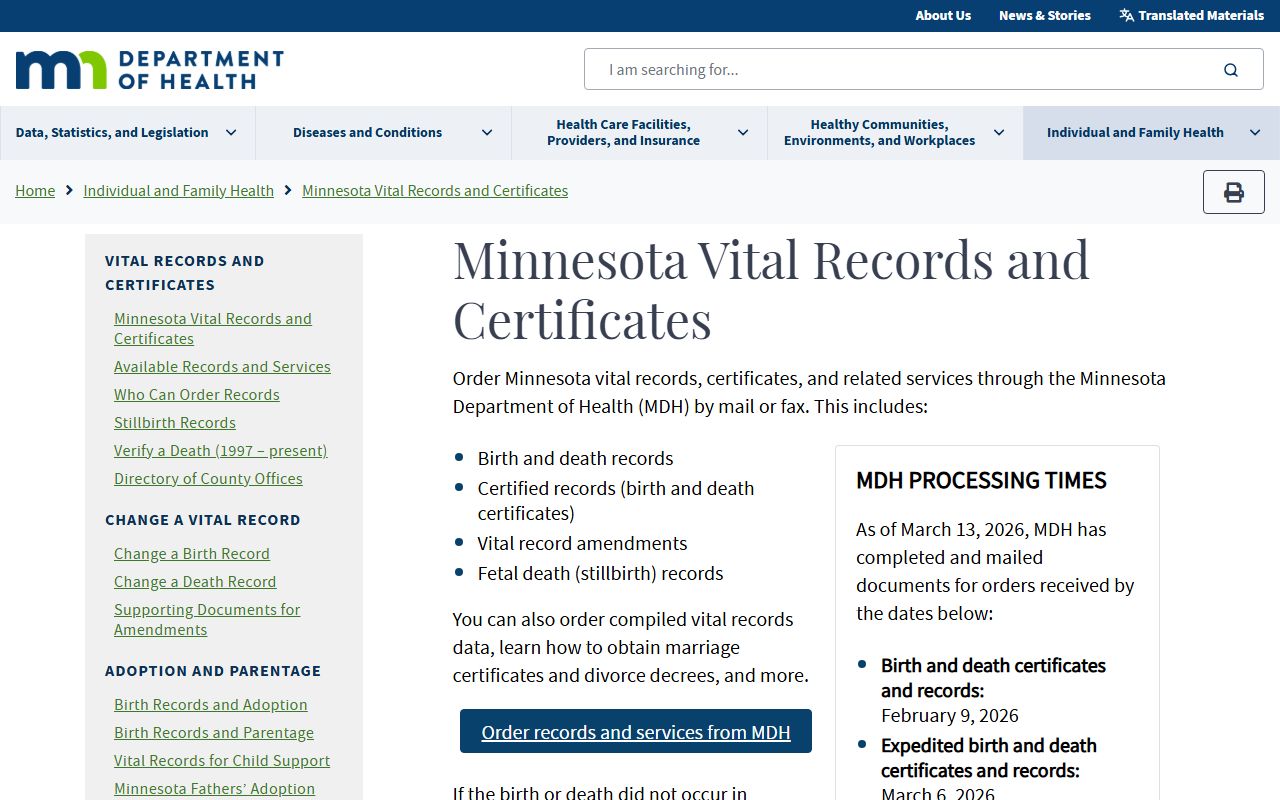
The MDH Vital Records page provides an overview of all vital records services available through the state and links to county-level offices where marriage licenses are issued.
Minnesota Marriage License Requirements
Both parties must be at least 18 years old to marry in Minnesota. Under Minnesota Statute 517.03, certain marriages are not allowed. These include marriages where either party has an existing unresolved prior marriage, marriages between close relatives by blood or adoption, and marriages between an uncle or aunt and a niece or nephew or between first cousins. Persons under a guardianship that limits the right to marry must obtain written consent from the Commissioner of Human Services before a license can be issued.
No blood test is required. Minnesota eliminated its waiting period on September 1, 2016. There is no residency requirement, so anyone can apply for a Minnesota marriage license regardless of where they live. If you were never married before, you simply show up with valid ID and fill out the application. If you have been married before, bring documentation showing how the prior marriage ended.
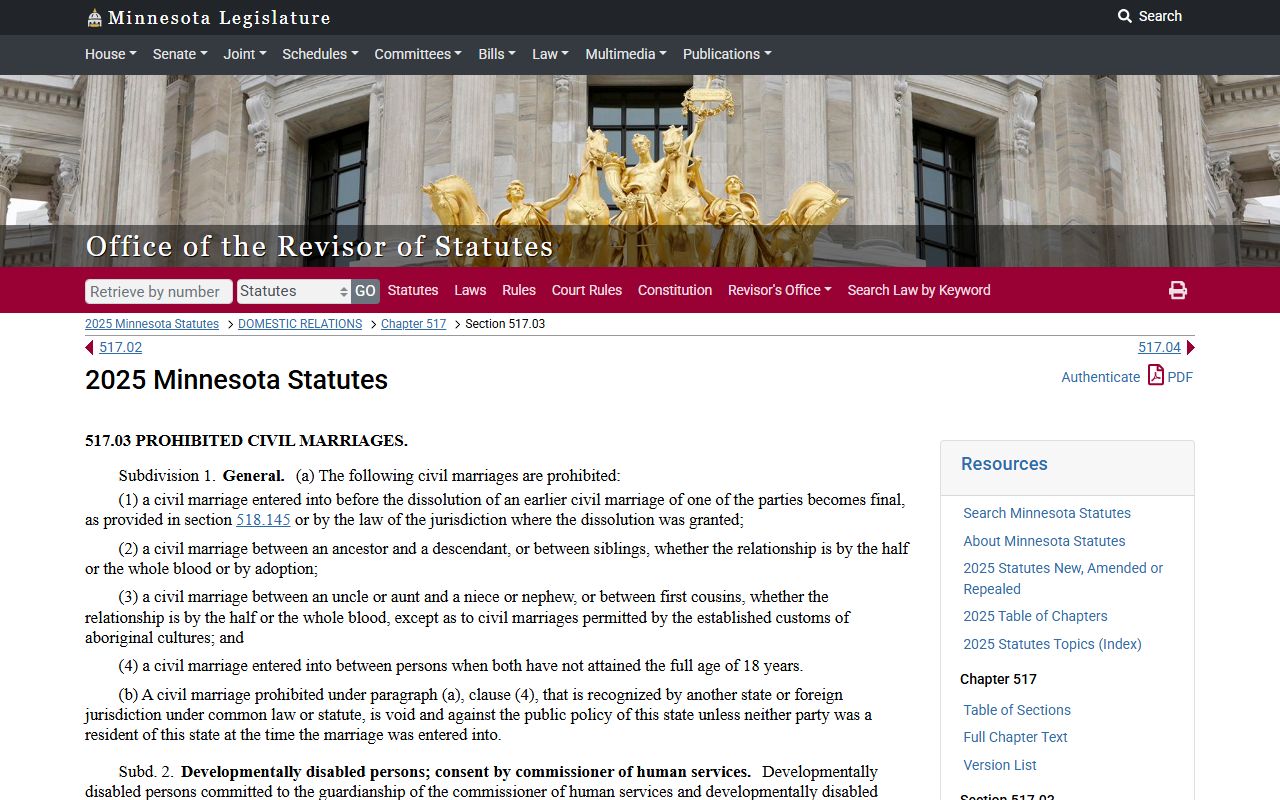
Minnesota Statute 517.03 lists the specific prohibited marriages in the state and explains the conditions under which a license cannot be issued, including situations involving existing marriages and certain family relationships.
What you need to bring to the county office:
- Valid government-issued photo ID for each applicant
- Social Security numbers for both parties
- Information about any prior marriages, including date and place of divorce or death
- A signed Educator's Statement if you want the reduced fee for completing premarital education
Minnesota Marriage License Fees
The standard fee for a Minnesota marriage license ranges from $115 to $125, depending on the county. Most counties charge $125 as of 2025. The state statute sets the base fee, and counties retain $25 with the rest going to state funds. Some counties do not accept credit cards and require cash or check, so it is worth calling your county office ahead of your visit to confirm payment options.
If you complete at least 12 hours of premarital education with a qualified educator, you may qualify for a reduced license fee of $40 to $50. You must submit the educator's signed statement at the time of application. The form must show both applicant names exactly as they appear on the marriage license application. This reduced fee option is set out in Minn. Stat. 517.08 Subd. 1b, and the educator's form is available from your county recorder's office.
Certified copies of a marriage certificate cost $9.00 each. You must request copies from the county that issued the original license. A re-issuance of a license with changes costs $20.00 in most counties. All fees are generally non-refundable once the license has been issued.
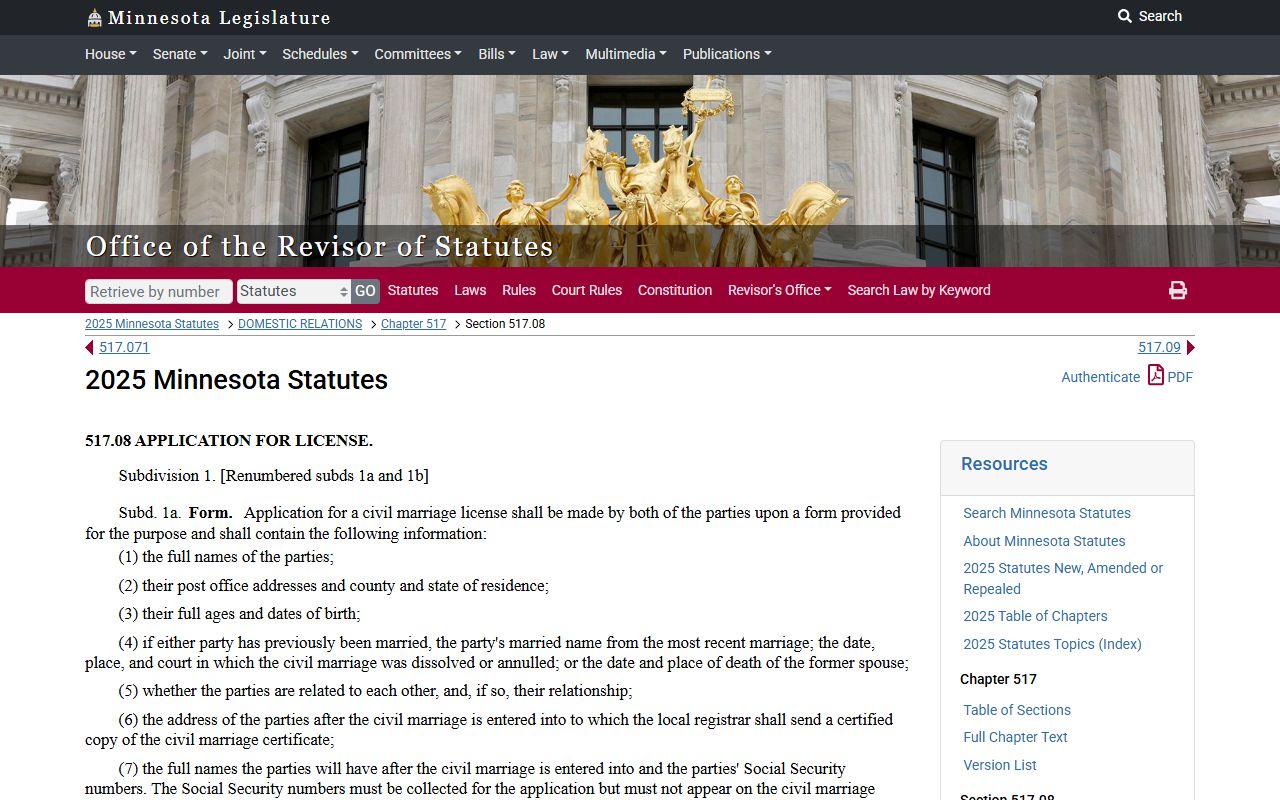
Minnesota Statute 517.08 covers the full requirements for the license application process, including the fee structure, what information must be collected, and the rules for applying when one party cannot appear in person.
Search Minnesota Marriage License Records Online
The Minnesota Official Marriage System, known as MOMS, is the statewide public database for marriage records. It is managed by the Minnesota Association of County Officers and covers 85 of Minnesota's 87 counties. You can search by last name, first name, middle name, and date range. The system is free to use and helps you find which county holds the official custodial record, which tells you exactly where to request a certified copy.
MOMS holds records going back to the early 1800s in some counties. Anoka County has records indexed from 1858. Hennepin County records go back to 1870. Dakota County records start from 1850. Some counties have marriage records from before Minnesota became a state in 1858, covering the territorial period. The system is updated on a regular basis and covers marriages through the current month in most participating counties.
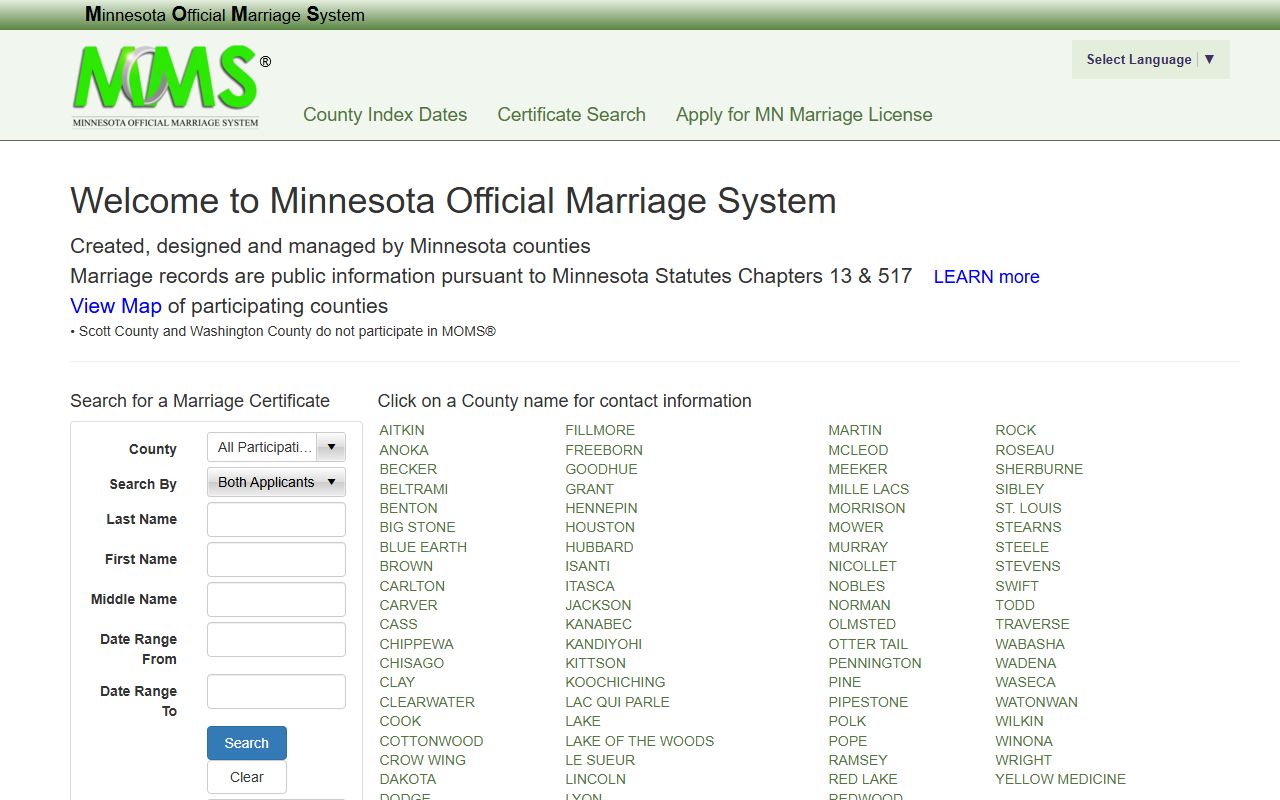
The Minnesota Official Marriage System (MOMS) is the central database where you can search marriage records from participating counties and submit online requests for certified copies.
Two counties do not use MOMS for certificate ordering: Scott County and Washington County. Scott County does not participate in the system at all, so marriage records there must be requested directly from the Scott County Government Center in Shakopee. Washington County handles requests through its own Taxpayer Services office in Stillwater. For all other counties, MOMS is the fastest way to find and request a marriage record.
Minnesota Marriage License Laws and Statutes
All civil marriage law in Minnesota is found in Minnesota Statutes Chapter 517. This chapter covers who can marry, how to apply for a license, who can perform a ceremony, what the officiant must do after the wedding, and how certified copies of marriage records can be obtained. The law defines civil marriage as a civil contract between two persons who are capable of making that contract.
Under Minn. Stat. 517.07, a license from a local registrar is required before any marriage ceremony can take place. The local registrar is typically the county recorder or auditor-treasurer. After the ceremony, the officiant must return the completed Certificate of Marriage to the issuing county within five days of the ceremony. Failure to file the certificate is a misdemeanor under Minn. Stat. 517.13. This requirement applies to all officiants, whether religious or civil.
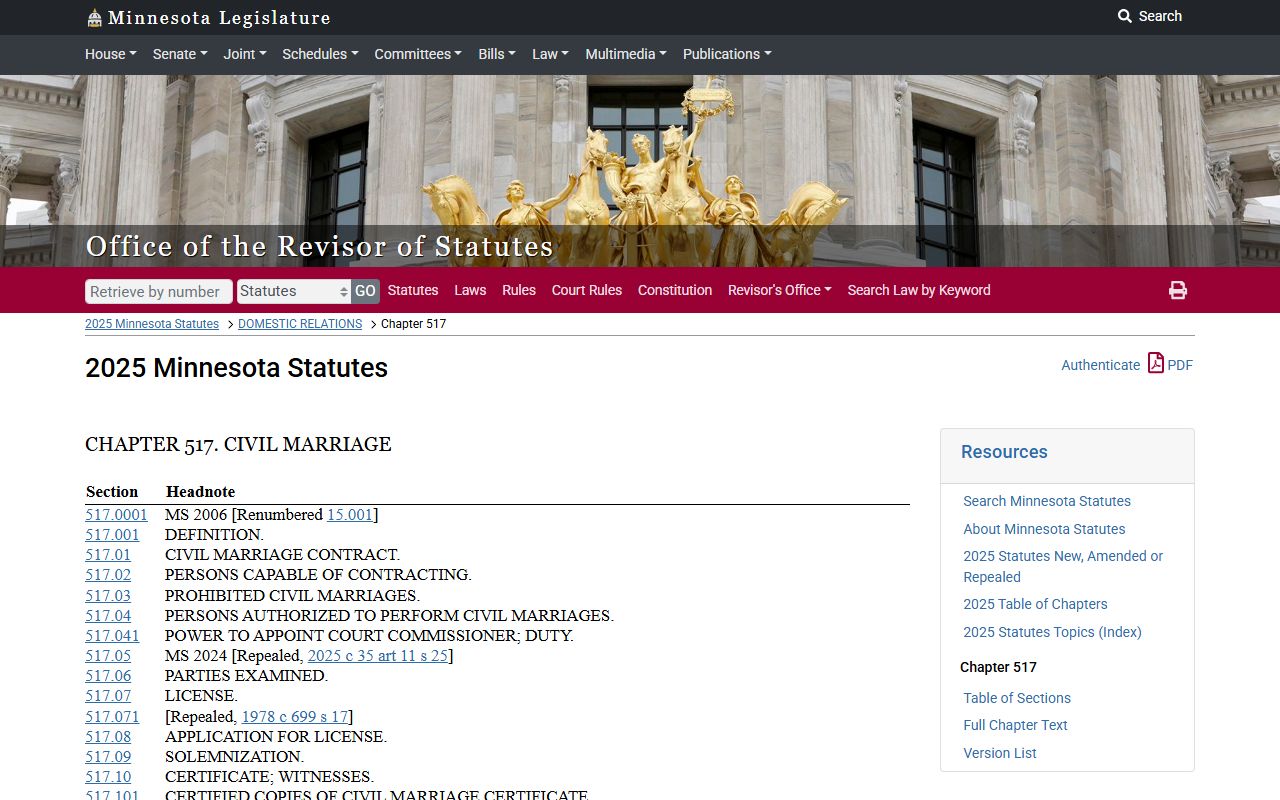
Minnesota Statutes Chapter 517 is the complete source for all civil marriage laws in the state, including sections on license applications, prohibited marriages, officiant requirements, and record-keeping rules.
Persons authorized to perform marriages in Minnesota under Minn. Stat. 517.04 include judges, retired judges, court administrators, licensed or ordained ministers, and civil celebrants. Any officiant who is not a sitting judge or court official must register their credentials with any Minnesota county before performing a ceremony. Once registered in one county, they may perform marriages anywhere in the state. The minimum age to register as an officiant is 21 years old.
As of August 1, 2023, persons with felony convictions cannot change their name through the marriage process. They must apply for a name change through district court. This change was made under Minnesota Statute 259.10. For most people without felony records, a name change after marriage is a straightforward process handled through the Social Security Administration and other agencies once you have your certified marriage certificate.
Marriage Reporting and County Responsibilities
County vital records offices in Minnesota serve as local registrars for the state. They issue marriage licenses, collect the completed certificates from officiants, and maintain the official record for every marriage licensed in the county. The Minnesota Department of Health provides oversight and requires counties to submit annual reports on the number of civil marriage licenses issued.
Monthly reporting was eliminated as of January 2025. Counties now report annually to MDH. Tribal marriage licenses are reported separately by emailing health.dataquality@state.mn.us. Electronic reporting tools are available through MDH for county offices that need them. All of this is outlined on the MDH Marriage Reporting page, which is intended for county registrar use.
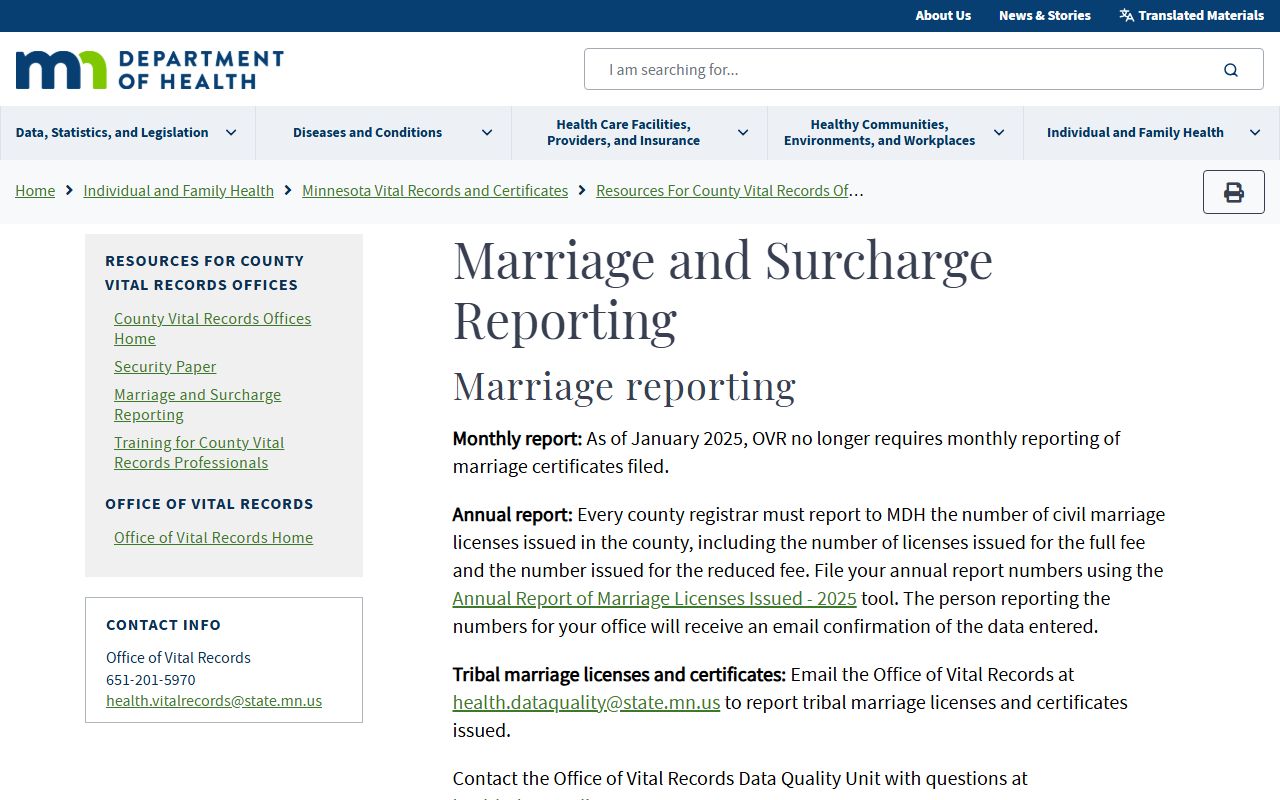
The MDH Marriage and Surcharge Reporting page explains how county registrars must report marriage data to the state, including the shift to annual reporting that took effect in 2025.
Getting a Minnesota Marriage Certificate Copy
A certified copy of a Minnesota marriage certificate must be obtained from the county that issued the original license. The record is filed in the county where the license was applied for, not necessarily where the ceremony took place. MDH does not process marriage certificate requests and refers all inquiries to the appropriate county office.
The fee is $9.00 per certified copy. You can request a copy in person, by mail, or online through MOMS if the county participates. When requesting by mail, send a written request that includes the couple's pre-marriage names and the date of marriage, along with a check or money order made out to the county recorder. Include a self-addressed stamped envelope so the county can send the certificate back to you. Processing times vary by county and workload.
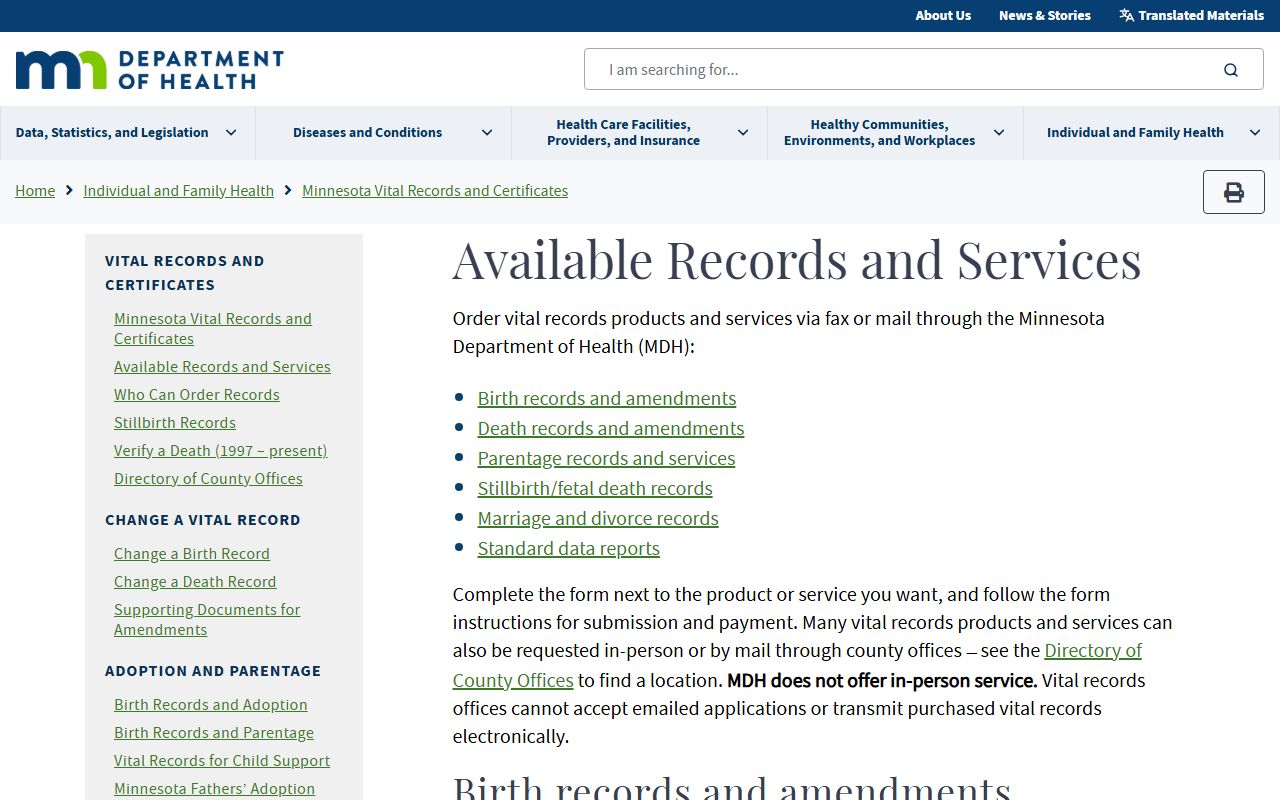
The MDH Available Records and Services page explains which vital records can be ordered through MDH versus through county offices, and confirms that marriage certificates are only available from the county that issued the license.
The Minnesota State Law Library has a plain-language guide to finding marriage certificates at mn.gov/law-library. The guide walks you through using MOMS to find which county holds the record and how to request a certified copy once you have that information.
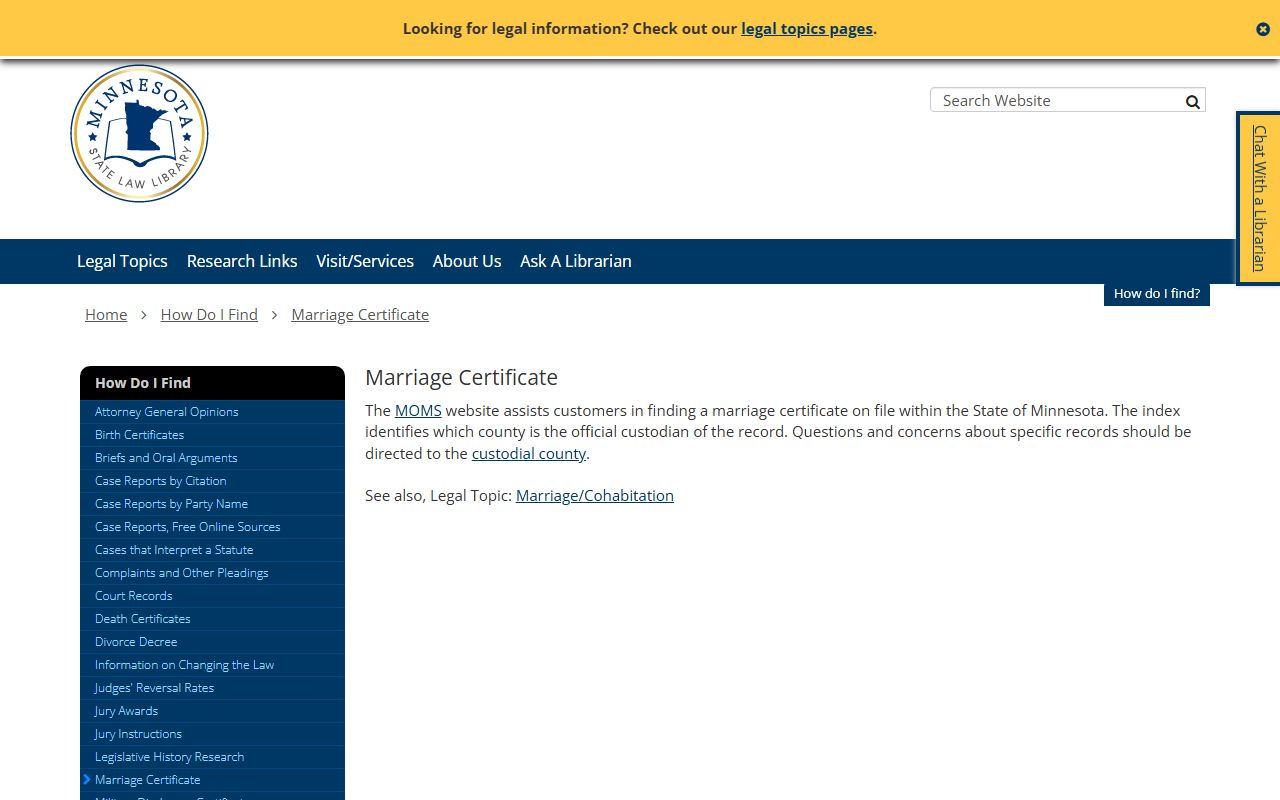
The Minnesota State Law Library guide walks you through the process of finding a marriage certificate and explains how to use the MOMS system to identify the custodial county.
Historical Minnesota Marriage Records
The Minnesota Historical Society holds one of the best collections of historical marriage records in the state. Their guide at libguides.mnhs.org/vital/marriage explains what types of records exist and how to find them. A marriage record typically includes the names of both parties, their residences, their ages, the date and place of marriage, and the name of the officiant who performed the ceremony. Some older records also include the names of witnesses.
Marriage records in Minnesota began in the 1850s. Ramsey and Washington counties have records going back to 1849, during the territorial period before statehood. The State Archives holds territorial marriage records from 1843 to 1849 from St. Croix County, Wisconsin, as well as justice of the peace records for certain Minnesota counties. The Gale Family Library at the Minnesota Historical Society in St. Paul is open to researchers. Contact them at reference@mnhs.org. The library does not provide certified copies but is an excellent resource for genealogy and family history research.
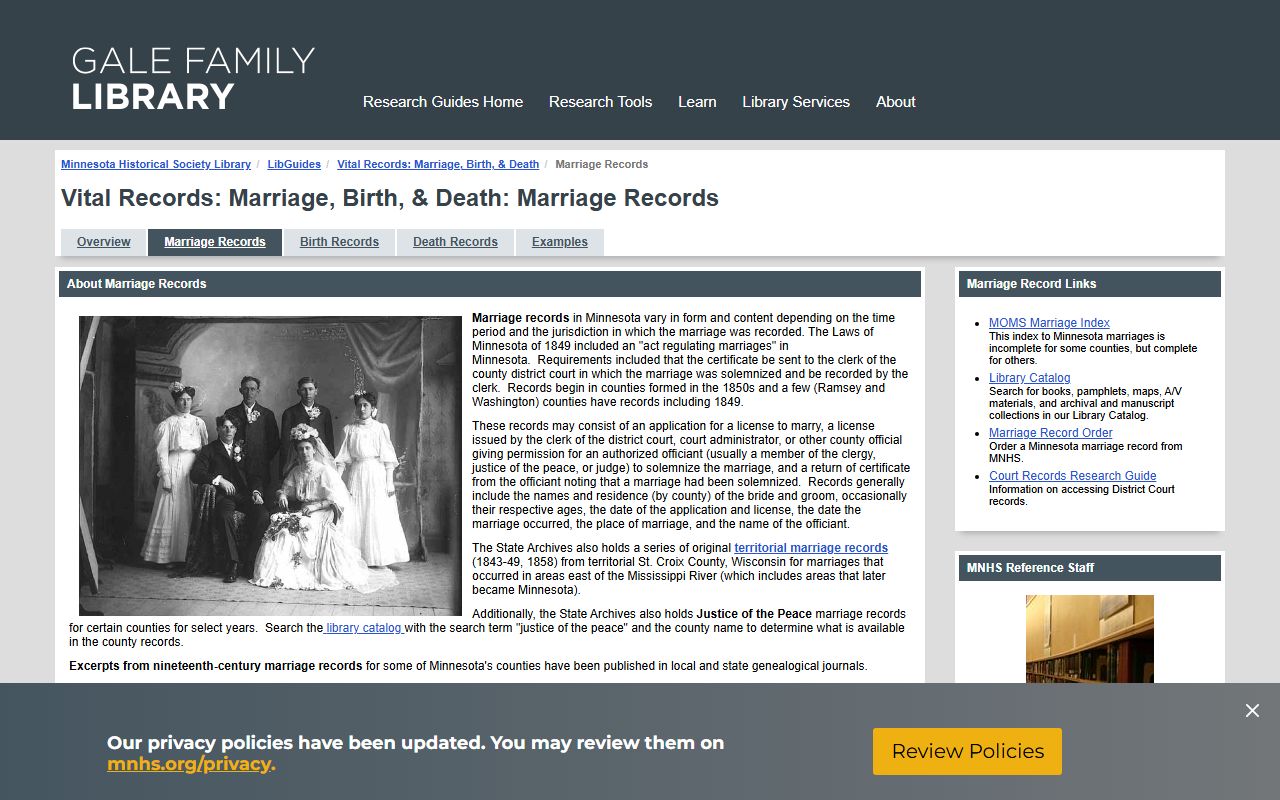
The MNHS Marriage Records Guide is the starting point for anyone researching historical Minnesota marriage records, including territorial-era documents and records that predate MOMS coverage.
Minnesota County Vital Records Offices
Each county in Minnesota has its own office that issues marriage licenses and maintains marriage records. Some counties use the county recorder's office. Others route marriage licenses through the auditor-treasurer or a license center. The MDH county directory is the most reliable source for current contact information.
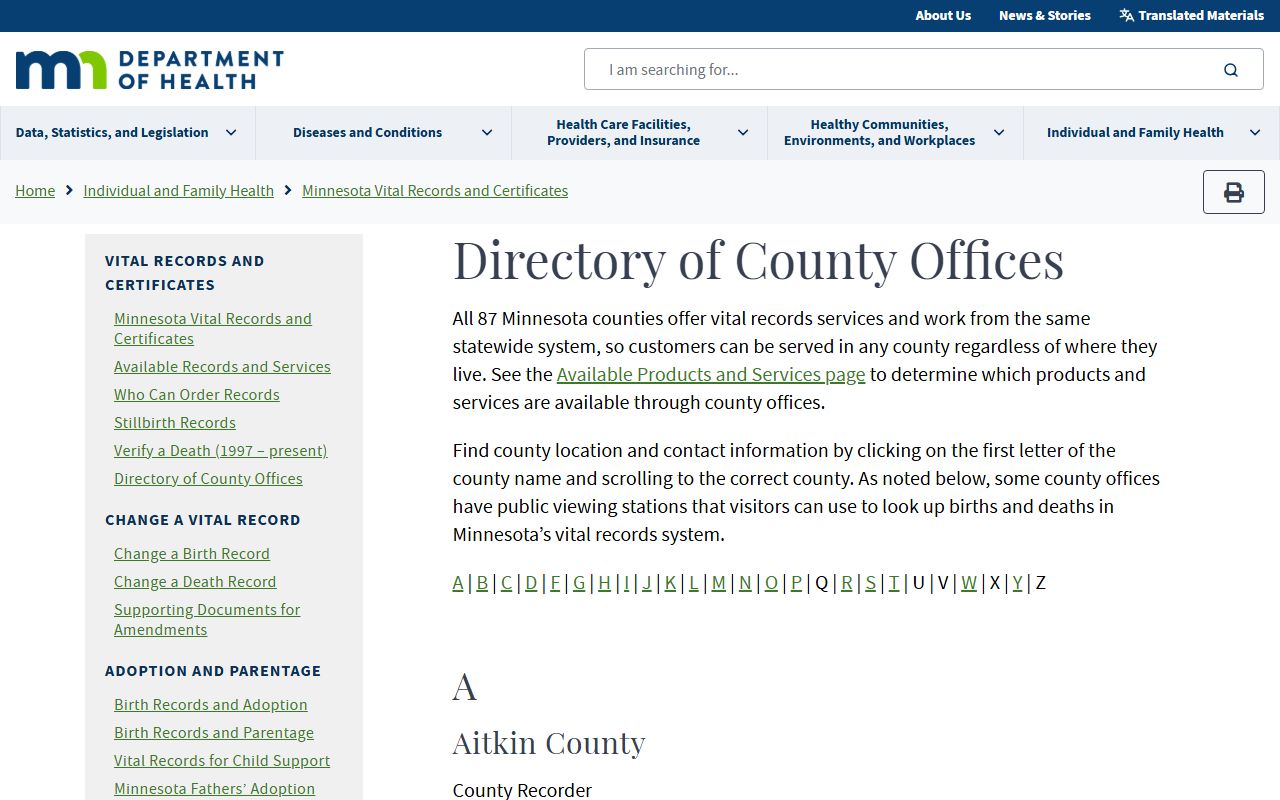
The MDH County Vital Records Directory lists all 87 Minnesota counties with phone numbers and addresses for each local registrar, making it easy to find the right office for your county.
Record history varies by county. Some counties have marriage records dating back to the 1850s, while newer counties formed in the early 1900s have shorter histories. Fees, payment methods, and office hours can differ from one county to the next, so it is worth confirming the details before you visit.
Apostille for Minnesota Marriage Certificates
If you need to use a Minnesota marriage certificate in another country, you may need an apostille. This is an authentication recognized by countries that have signed the Hague Apostille Convention. In Minnesota, apostille services are handled by the Minnesota Secretary of State's office, not the Department of Health.
The cost is $5.00 per document. You must submit the original certified copy of your marriage certificate along with the apostille request. Mail or bring the documents to the Secretary of State's office at 332 Minnesota Street, Suite N201, Saint Paul, MN 55101. Minnesota only issues apostilles, not general authentications. All current instructions and forms are available at sos.mn.gov/notary-apostille.
The Minnesota Secretary of State Apostille Services page has current requirements and submission instructions for getting an apostille on a marriage certificate for use in foreign countries.
Browse Minnesota Marriage License Records by County
Each of Minnesota's 87 counties issues marriage licenses and holds the official records for licenses applied for there. Select a county below to find local contact information, fees, office hours, and resources for marriage license records in that area.
View All 87 Minnesota Counties
Marriage License Records in Major Minnesota Cities
Minnesota cities do not issue marriage licenses. Residents apply at the county recorder's office that serves their city. Select a city below to find out which county office to contact for marriage license records in that area.